Event hosted by Reconciling Ways of Knowing (see details below): Join us on October 26 for the next in our series of online dialogues, “Stewarding Our Marine Relations.” After a number of Dialogues focused on land-use planning and stewarding our relations in land-based environments, we’re pleased to dedicate our next Reconciling Ways of Knowing: Indigenous […]
Information from 2021IMW Turtle Island Website: INDIGENIZE THE MAP After the success of our first ever virtual Indigenous Mapping Workshop, we are very excited to announce the launch of 2021IMW: Turtle Island. Happening over a period of 5 days, participants will develop their skills with cutting edge geospatial technologies that can be used to share […]
Virtual Event Information from ArcticNet: Hosted entirely online December 6 - 10, 2021, the ArcticNet Virtual Annual Scientific Meeting 2021 (ASM2021) is a hub for Arctic research in Canada. The ASM2021 brings together researchers from the natural, health, and social sciences to meet the challenges and opportunities of a rapidly changing Arctic region, shaped by […]
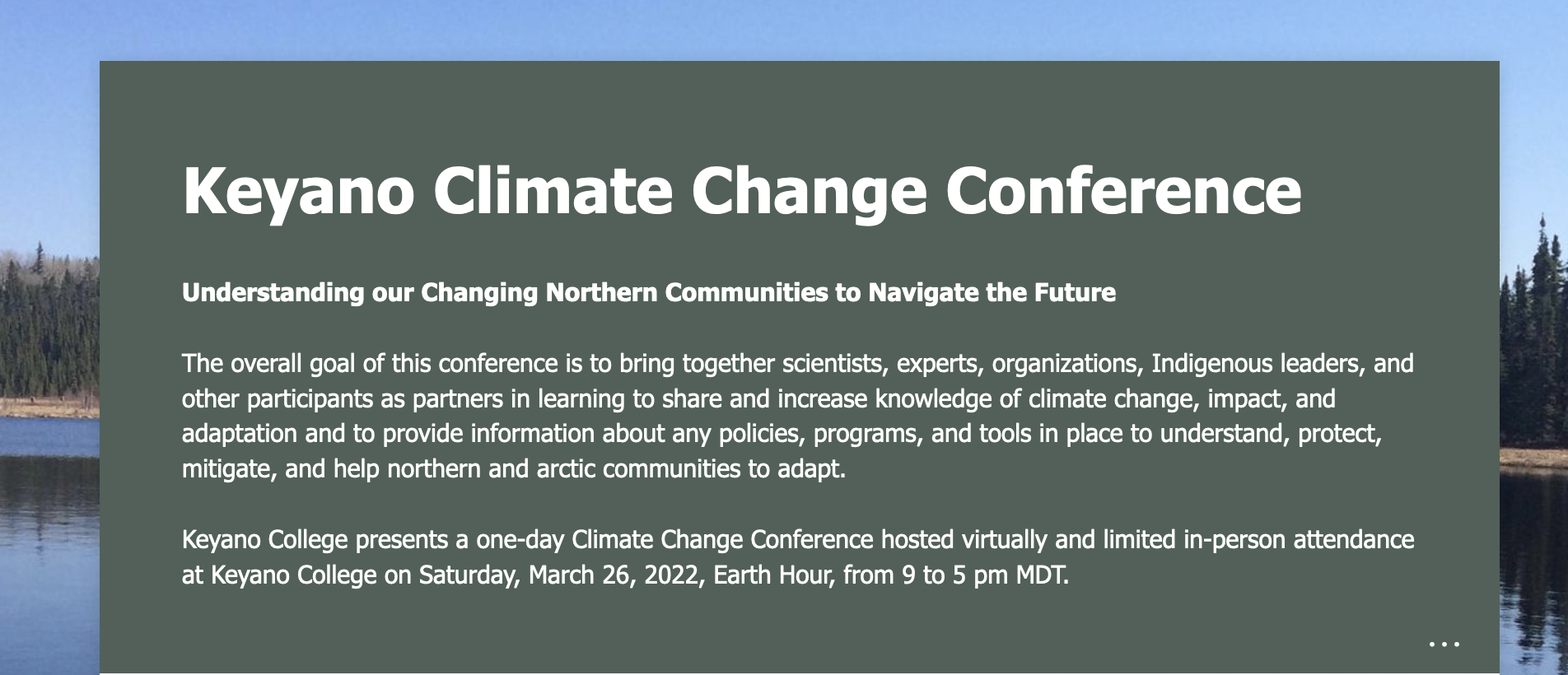
Understanding our Changing Northern Communities to Navigate the Future Keyano College presents a one-day Climate Change Conference hosted virtually and in-person at Keyano College on Saturday, March 26, 2022, Earth Hour, from 9 a.m. to 5 p.m. MDT. What is The Climate Change Conference? The overall goal of this conference is to bring together scientists, […]
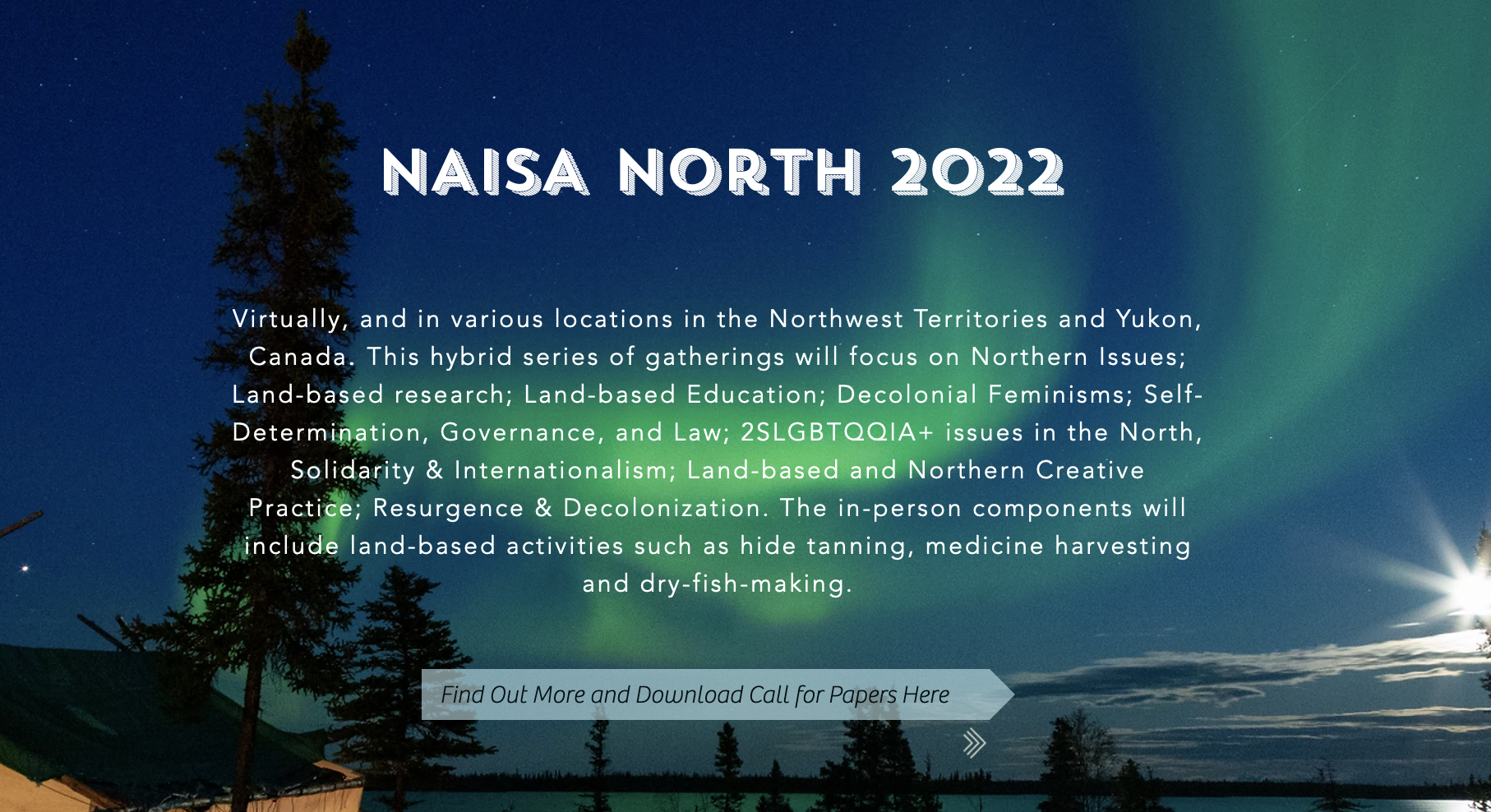
Location: Virtually, and in various locations in the Northwest Territories and Yukon, Canada Dates: Virtual Programming; May 15 to June 15 In-Person Programming - Whitehorse: May 25-27 In-Person Programming - Yellowknife: June 23-25. Other community programs TBC. This hybrid series of gatherings will focus on Northern Issues; Land-based research; Land-based Education; Decolonial Feminisms; Self-Determination, Governance, […]
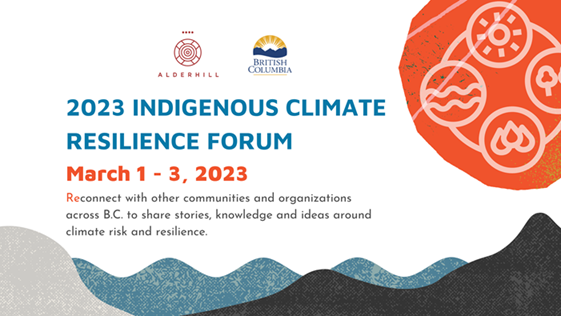
The second Indigenous Climate Resilience Forum (ICR Forum) will be taking place virtually from March 1-3, 2023. The ICR Forum is a free, virtual event designed to inform, connect and support Indigenous communities in climate adaptation and resilience. This year’s theme is climate change risk and resilience. This Forum is being hosted by Alderhill Planning […]
The B.C. Climate Action Secretariat and the B.C. Ministry of Energy and Climate Solutions is pleased to invite you to the fourth annual Indigenous Climate Resilience Forum, which will focus closely on Today, Tomorrow and Beyond – Climate Resilience One Step at a Time, taking place February 18 – 20, 2025. More speakers will be announced […]
Webinar: Mapping Social Vulnerability for Climate Action Planning As we see the rise of climate change impacts, extreme weather events such as urban heat islands are disproportionately experienced by communities living in socially vulnerable areas. Climate equity is the goal of recognizing and addressing unequal burdens of climate change, while ensuring that the benefits of […]
Canada is currently undergoing an energy transformation driven by the urgent need to collectively address climate change across all sectors. Achieving net zero requires the clean power sector to grow significantly over the coming years. Indigenous leadership can and should be at the heart of this shift. Indigenous nations are rightsholders to vast territories, and […]
ClimateWest has partnered with NAMS Canada to offer subsidized asset management training opportunities. Register for Expanded Professional Certificate in Asset Management Planning to strengthen your asset management expertise while integrating climate resilience, equity, and green infrastructure into your asset management plan. During the course, participants will prepare a draft asset management plan using their own […]
Concordia University
Pavillon J.‐W.‐McConnell 1400 De Maisonneuve Blvd. W., Montreal, QC, Canada
Mitigating the Impacts of Climate Change is a series separate workshops featuring speakers who share their insights on Indigenous environmental leadership, community action, and land-based learning.
Join us as Anishnabe Knowledge Keeper Shannon Chief/Waba Mako discusses various contributions to the decolonization and restoration of her people’s sovereignty, including the defense and protection of land, waters, and language and the community-driven Anishnabe Moose Studies project.
Speaker
Shannon Chief/Waba Mako is Wolf Clan from the Anishnabe-Algonquin Nation. She contributes at various levels to the decolonization and the restoration of her people’s sovereignty. The defense and protection of land, waters and language is a priority for the Anishnabeg. Waba is a Knowledge Keeper who prioritizes knowledge & language sharing to Anishnabe communities. Waba is the former AMC coordinator for the Anishnabe Moose Studies which has always been community-driven project from 2022 to 2025. Today, Waba is the Interium Managing Director for Tinakiwin, a newly non profit organization established to continue on the advocacy work within the Algonquin Territory.
Concordia University
Pavillon J.‐W.‐McConnell 1400 De Maisonneuve Blvd. W., Montreal, QC, Canada
Mitigating the Impacts of Climate Change is a series separate workshops featuring speakers who share their insights on Indigenous environmental leadership, community action, and land-based learning.
In the face of global climate change, Mohawk educator and pedagogical consultant Kanerahtiio Hemlock asks, “How do small communities respond and adapt?” Acknowledging that there is no one right answer, Kanerahtiio explains that for traditional Native people, the path is clear: “We have to return to our own ways.” In this workshop, Kanerahtiio speaks to what he has learned while developing a class on Indigenous self-sustainability, and how exploring the ways his people taught their children in the past—and what that teaching might look like today—has guided this educational work.
Speaker
Kanerahtiio Hemlock, a Mohawk from Kahnawake, has taught native history for the past thirteen years at the First Nations Regional Adult Education Center. During that time, he had developed a course on Indigenous self-sustainability that won the 2018 Ken Spencer national award for innovation in teaching. Since 2023 he has also worked part time at Dawson College as the Indigenous Pedagogical Consultant.