Indigenous Centre for Cumulative Effects’ (ICCE) National Conference
The 2023 conference theme is Sharing Knowledge to Take Action and will be held May 29 to 31, 2023 at the Westin Hotel in Ottawa, Ontario. The Westin Hotel is […]
The B.C. Climate Action Secretariat and the B.C. Ministry of Energy and Climate Solutions is pleased to invite you to the fourth annual Indigenous Climate Resilience Forum, which will focus […]
TechNations will take place in Niagara Falls, Ontario, at the Sheraton Fallsview Hotel on Monday, May 12 and Tuesday, May 13, 2025. The theme for this year is Empowering Future […]
Webinar: Mapping Social Vulnerability for Climate Action Planning As we see the rise of climate change impacts, extreme weather events such as urban heat islands are disproportionately experienced by communities […]
Canada is currently undergoing an energy transformation driven by the urgent need to collectively address climate change across all sectors. Achieving net zero requires the clean power sector to grow […]
ClimateWest has partnered with NAMS Canada to offer subsidized asset management training opportunities. Register for Expanded Professional Certificate in Asset Management Planning to strengthen your asset management expertise while integrating […]
Speaker: Cole Teionieh’táthe Delisle works as an Environmental Projects Coordinator for Terrestrial Habitats with a wide range of projects. He coordinates KEPO's seed saving activities, EAB project, species at risk, bird program, and drone work. A graduate from Concordia University’s Anthropology program, he is interested in archeology and the community’s history. Outside of terrestrial work, he also leads Kahnawà:ke's participation in Transport Canada's Enhanced Maritime Situational Awareness Program monitoring the impacts of industrial shipping.
Audience: Concordia community and external
This event has been generously funded by the Chamandy Foundation.

In this workshop, Inuk climate emotion researcher, Diane Obed, invites participants into a space of inquiry that honors Indigenous paradigms of relationality, where emotions are not pathologies to fix, but relational feedback mechanisms from the lands, waters, skies, kinfolk, we are entangled with.
Together, we’ll explore:
What shifts when we treat climate grief and fear not as dysfunction, but as relational intelligence?
How Indigenous land-based worldviews metabolize emotion through kinship, ceremony, and responsibility.
Expect reflection, dialogue, and gentle embodied practices, not as solutions, but as invitations to listen differently to what moves through us when the land speaks.
Speaker: Diane Obed is an Inuk woman mixed with English ancestry, originally from Hopedale, Nunatsiavut, Labrador. She currently lives in Nalikitquniejk– “place of torn branches” in Mi’kma’ki, in the territory of Peace and Friendship Treaties, also known as Antigonish, Nova Scotia.
Diane is currently studying in the Inter-University Educational Foundations PhD program at Mount Saint Vincent University. Her doctoral research project explores the intersections between Indigenous land education and contemplative studies to draw on ancient wisdom for modern day psycho-social issues such as cultivating courage to be able to face and engage in dialogue about the current climate crisis.
Audience: Concordia community and external
This event has been generously funded by the Chamandy Foundation.
Join us in Vancouver for the inaugural First Nations Investment Forum (FNIF)—the first national conference led and organized by First Nations to accelerate Indigenous investment, ownership, and economic sovereignty. As […]
Mitigating the Impacts of Climate Change is a series separate workshops featuring speakers who share their insights on Indigenous environmental leadership, community action, and land-based learning.
Join us as Anishnabe Knowledge Keeper Shannon Chief/Waba Mako discusses various contributions to the decolonization and restoration of her people’s sovereignty, including the defense and protection of land, waters, and language and the community-driven Anishnabe Moose Studies project.
Speaker
Shannon Chief/Waba Mako is Wolf Clan from the Anishnabe-Algonquin Nation. She contributes at various levels to the decolonization and the restoration of her people’s sovereignty. The defense and protection of land, waters and language is a priority for the Anishnabeg. Waba is a Knowledge Keeper who prioritizes knowledge & language sharing to Anishnabe communities. Waba is the former AMC coordinator for the Anishnabe Moose Studies which has always been community-driven project from 2022 to 2025. Today, Waba is the Interium Managing Director for Tinakiwin, a newly non profit organization established to continue on the advocacy work within the Algonquin Territory.
Mitigating the Impacts of Climate Change is a series separate workshops featuring speakers who share their insights on Indigenous environmental leadership, community action, and land-based learning.
In the face of global climate change, Mohawk educator and pedagogical consultant Kanerahtiio Hemlock asks, “How do small communities respond and adapt?” Acknowledging that there is no one right answer, Kanerahtiio explains that for traditional Native people, the path is clear: “We have to return to our own ways.” In this workshop, Kanerahtiio speaks to what he has learned while developing a class on Indigenous self-sustainability, and how exploring the ways his people taught their children in the past—and what that teaching might look like today—has guided this educational work.
Speaker
Kanerahtiio Hemlock, a Mohawk from Kahnawake, has taught native history for the past thirteen years at the First Nations Regional Adult Education Center. During that time, he had developed a course on Indigenous self-sustainability that won the 2018 Ken Spencer national award for innovation in teaching. Since 2023 he has also worked part time at Dawson College as the Indigenous Pedagogical Consultant.
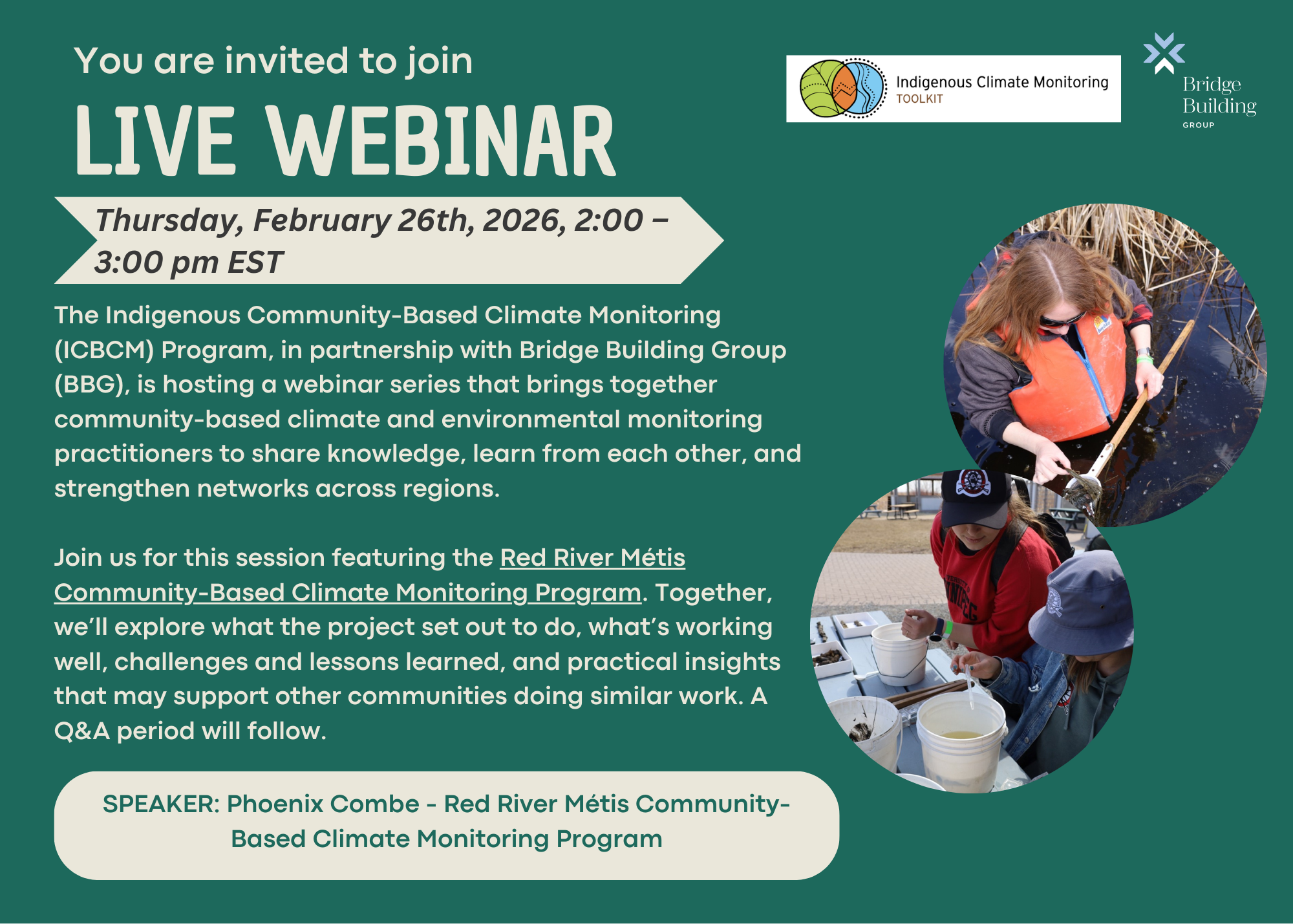
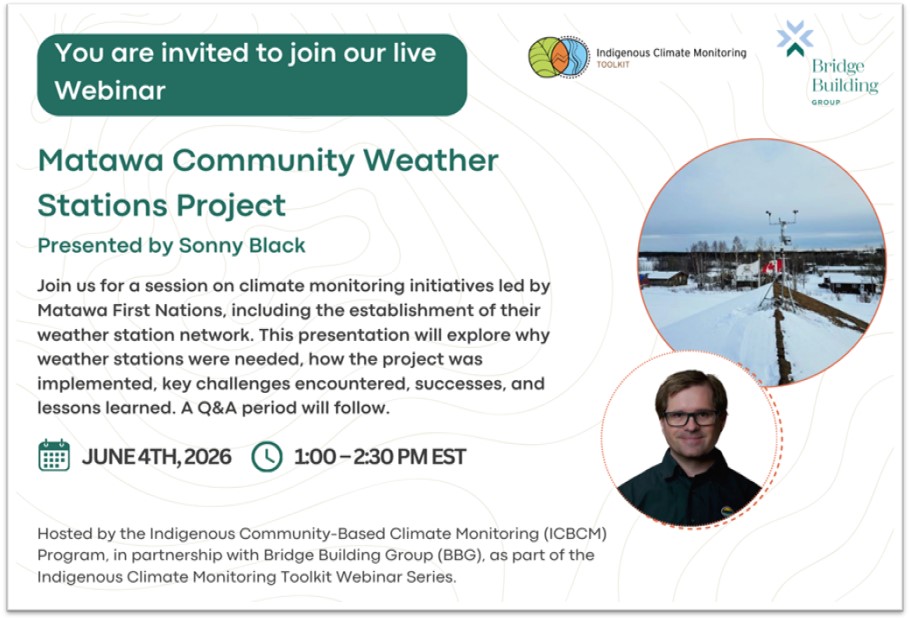
The Indigenous Community-Based Climate Monitoring (ICBCM) Program, in partnership with Bridge Building Group (BBG), is hosting a webinar series that brings together community-based climate and environmental monitoring practitioners to share knowledge, learn from each other, and strengthen networks across regions.
Join them at 2:00 PM EST on Thursday, February 26, 2026, for a session featuring the Red River Métis Community-Based Climate Monitoring Program. Together, they'll explore what the project set out to do, what’s working well, challenges and lessons learned, and practical insights that may support other communities doing similar work. A Q&A period will follow.